2021 Solved Old Paper (BOT - 403D) New OK

%20of%20New%20Picture.png)
%20of%20New%20Picture.png)
%20of%20New%20Picture.png)

%20of%20New%20Picture.png)
कायिक क्लोनीय विविधताएँ (Somaclonal Variations):-
सामान्य परिचय (General Introduction):-
· परिभाषा (Definition):- पादप ऊत्तक संवर्धन के द्वारा पादपों में उत्पन्न होने वाली आनुवंशिक विविधताएँ जिन्हें लक्षण प्रारूप के रूप में देखा जा सकता है।
(The genetic variations that develops in plants through plant tissue culture and which can be seen as phenotypes.)
· इसमें गुणसूत्रों की संख्या व संरचना में परिवर्तन हो जाता है जिससे पादपों के निम्न लक्षणों में परिवर्तन आ जाता है:-
(In this, the number and structure of chromosomes changes, due to which the following characteristics of plants change.)
i. पर्ण की आकृति व रंग (Leaf shape and colour)
ii. वृद्धि दर (Growth rate)
iii. स्वभाव (Habit)
iv. लैंगिक उर्वरता (Sexual fertility)
· ये आनुवंशिक उत्परिवर्तन होते हैं जो पादपों में पीढ़ी दर पीढ़ी वंशागत होते हैं।
(These are genetic mutations that are inherited from generation to generation in plants.)
%20of%20New%20Picture.png)
%20of%20New%20Picture.png)
%20of%20New%20Picture.png)
%20of%20New%20Picture.png)
.bmp)
.bmp)
.png)
.png)
भ्रूण बचाव (Embryo Rescue):-
1. सामान्य परिचय (General Introduction):-
· परिभाषा (Definition):- ऐसा अपरिपक्व या कमजोर भ्रूण जो नष्ट हो सकता है व अपने आप पौधे में विकसित नहीं हो सकता उसे ऊतक संवर्धन तकनीक के द्वारा स्वस्थ पौधे में विकसित करने की प्रक्रिया को भ्रूण बचाव कहते हैं।
(Through tissue culture technique, the process of developing a healthy plant from an immature or weak embryo, which can be destroyed and cannot develops into the plant on its own, is called embryo rescue.)
· दूरस्थ संकरण से भ्रूणपोष का सही प्रकार से विकास नहीं हो पाता है जिससे भ्रूण के नष्ट होने की संभावना बढ़ जाती है।
(Endosperm does not develop properly in distant hybridization, which increases the chances of embryos being destroyed.)
· भ्रूण बचाव प्रक्रिया में कृत्रिम पोषक माध्यम भ्रूणपोष के विकल्प का कार्य करता है। जिससे भ्रूण का विकास बिना रुके लगातार चलता रहता है।
(The artificial nutrient medium serves as an alternate of endosperm in the embryo rescue process. Due to which the development of the embryo continues continuously without stopping.)
2. सिद्धान्त (Principle):- भ्रूण विकास 3 अवस्थाओं में होता है। पोषण आवश्यकता उसी के अनुसार परिवर्तित होती रहती है।
(Embryonic development occurs in 3 stages. The nutritional requirement varies accordingly.)
i. विषमपोषी अवस्था (Heterotrophic Phase):- यह एक प्रारम्भिक अवस्था है जिसमें भ्रूण पोषकों की आपूर्ति के लिए अधिकतर भ्रूणपोष व मातृक ऊतक पर निर्भर रहता है।
(This is an early stage in which the embryo mostly depends on endosperm and maternal tissue for supplying nutrients.)
ii. स्वपोषी अवस्था (Autotrophic Phase):- इस अवस्था में भ्रूण में वृद्धि के लिए आवश्यक पदार्थों के निर्माण के लिए उपापचय क्षमता विकसित हो जाती है। जिससे भ्रूण धीरे धीरे आत्मनिर्भर हो जाता है।
(At this stage, metabolic capacity is developed in the embryo to produce the necessary substances for growth. By which the embryo gradually becomes self-dependent.)
iii. मध्यस्थ अवस्था (Intervening Phase):- यह विषमपोषी व स्वपोषी अवस्था के मध्य की नाजुक अवस्था है। इस अवस्था पर पोषक आपूर्ति अत्यधिक परिवर्तनशील होती है जो अधिकतर पादप जाति पर निर्भर करती है।
(It is a critical stage between heterotrophic and autotrophic. Nutrient supply at this stage is highly variable, depending mostly on plant species.)
· परिपक्व भ्रूण की तुलना में अपरिपक्व भ्रूण संवर्धन के लिए अधिक जटिल माध्यम की आवश्यकता होती है।
(Immature embryos require a more complex medium than mature embryos for culturing.)
· भ्रूण के पूर्ण विकास के लिए इसे कई बार एक माध्यम से निकालकर दूसरे माध्यम में स्थानांतरित करना पड़ता है।
(For complete development of the embryo, it has to be removed from one medium and transferred to another medium.)
3. भ्रूण बचाव के लिए आवश्यक कारक (Factors Required for Embryo Rescue):-
a. माध्यम (Medium):-
· भ्रूण बचाव के लिए अधिकतर MS माध्यम व B5 माध्यम का उपयोग किया जाता है।
(Mostly MS medium and B5 medium are used for embryo rescue.)
· माध्यम का प्रकार व घटक भ्रूण विकास की अवस्था पर निर्भर करता है।
(The type and component of the medium depends on the stage of embryo development.)
· विषमपोषी अवस्था के भ्रूण के लिए जटिल माध्यम की आवश्यकता होती है।
(The heterotrophic stage embryo requires a complex medium.)
Ø ग्लूटेमिन व ऐस्पार्जिन अमीनो अम्ल
(Glutamine and Aspargine amino acids)
Ø विभिन्न विटामिन्स (Different vitamins)
Ø कैसीन हाइड्रोलाइसेट (Casein hydrolysate):-
ये विभिन्न अमीनो अम्लों से प्रचुर होते हैं जिनका उपयोग कई बार किया जाता है।
(They are rich in various amino acids which is used many times.)
Ø सुक्रोज (Sucrose):- इसका उपयोग ऊर्जा स्त्रोत व ओस्मेटिकम के रूप में किया जाता है।
(It is used as an energy source and osmaticum.)
Ø अमोनियम नाइट्रेट (Ammonium Nitrate):- नाइट्रोजन स्त्रोत के लिए इसका उपयोग किया जाता है।
(It is used for nitrogen sources.)
Ø नारियल का द्रव भ्रूणपोष (Liquid Endosperm of Cocconut):-
यह माध्यम में विशिष्ट अमीनो अम्ल, शर्करा, वृद्धि नियामक आदि की आपूर्ति करता है।
(It supplies specific amino acids, sugars, growth regulators etc. in the medium.)
Ø सामान्यतया वृद्धि नियामकों की आवश्यकता नहीं होती है क्योंकि ये कैलस निर्माण को प्रेरित करते हैं।
(Growth regulators are generally not required as they induce callus formation.)
Ø भ्रूण वृद्धि के लिए pH 5.0 से 7.5 के मध्य रखी जाती है।
(The pH is kept between 5.0 and 7.5 for embryo growth.)
· स्वपोषी अवस्था के भ्रूण के लिए सरल माध्यम की आवश्यकता होती है।
(Autotrophic stage embryos require simple medium.)
· अंकुरण के लिए सुक्रोज युक्त सरल अकार्बनिक माध्यम की आवश्यकता होती है।
(Germination requires a simple inorganic medium containing sucrose.)
b. ताप व प्रकाश (Temperature and Light):-
· रबी फसलों के भ्रूण विकास के लिए कम तापमान की आवश्यकता होती है जबकि खरीफ फसलों के भ्रूण विकास के लिए उच्च तापमान की आवश्यकता होती है।
(Low temperature is required for embryonic development of rabi crops whereas high temperature is required for embryonic development of kharif crops.)
· असामयिक अंकुरण को रोकने के लिए प्रारम्भिक संवर्धन अंधेरे में किया जाता है। अंधेरे में 1 – 2 सप्ताह रखने के पश्चात पर्णहरित निर्माण के लिए बाद में इसे प्रकाश में स्थानांतरित कर दिया जाता है।
(Initial culture is done in the dark to prevent premature germination. After keeping 1 - 2 weeks in the dark, it is later transferred to the light for chlorophyll formation.)
4. भ्रूण बचाव की सामान्य विधियाँ (General Embryo Rescue Procedures):-
i. भ्रूण संवर्धन (Embryo Culture)
ii. बीजाण्ड संवर्धन (Ovule Culture)
iii. अंडाश्य संवर्धन (Ovary Culture)
i. भ्रूण संवर्धन (Embryo Culture):-
· यह भ्रूण बचाव की बहुत अधिक सामान्य प्रक्रिया है जिसमें भ्रूणो को निकालकर सीधे संवर्धन माध्यम पर स्थापित किया जाता है।
(It is a very common process of embryo rescue in which embryos are extracted and placed directly on the culture medium.)

· ऐसे नियंत्रित परागण वाले पौधों के फल जिनमें भ्रूण के नष्ट होने की संभावना रहती है उन्हें समय से पहले एकत्रित कर लिया जाता है।
(The fruits of such controlled pollinated plants, which are prone to embryo destruction, are collected before maturation.)
· बीजों के अन्दर उपस्थित अपरिपक्व भ्रूण निर्जमित अवस्था में होते हैं इसलिए इनके निर्जमीकरण की आवश्यकता नहीं होती है। कुछ मामलों में सम्पूर्ण अंडाशय का सतही निर्जमीकरण किया जाता है।
(Immature embryos present in the seeds are in sterilized state, so they do not require sterilization. In some cases surface sterilization of the entire ovary is done.)
· भ्रूण को बीज से निकालने के तुरन्त बाद सीधे माध्यम पर स्थापित कर दिया जाता है इसलिए यह सूखता नहीं है। हृदय नुमा व तरुण भ्रूणो को इनके निलंबक सहित साबुत निकालना चाहिए।
(The embryo is placed directly on the medium immediately after it is extracted from the seed so it does not dry up. Heart shaped and young embryos should be removed intact with their suspensors.)
ii. बीजाण्ड संवर्धन (Ovule Culture):-
· बहुत अधिक छोटे बीज वाली जतियों से व बहुत अधिक तरुण भ्रूणो को निकालना कठिन होता है। भ्रूण को निकालते समय इनके क्षतिग्रस्त होने का खतरा रहता है। भ्रूण को क्षतिग्रस्त होने से बचाने के लिए इसे बीजाण्ड के अन्दर रखकर ही संवर्धित किया जाता जाता है। इस तकनीक को बीजाण्ड संवर्धन कहते हैं।
(It is difficult to remove embryos from very small seeds and very young embryos. There is a risk of damage to the embryo while removing it. To protect the embryo from being damaged, it is cultured only by keeping it inside the ovule. This technique is called ovule culture.)

· ऐसे नियंत्रित परागण वाले पौधों के पुष्प जिनमें भ्रूण के नष्ट होने की संभावना रहती है उन्हें निषेचन के तुरन्त बाद एकत्रित कर लिया जाता है। अंडाशय का सतही निर्जमीकरण करके इसके अन्दर से बीजाण्डों को निकालकर माध्यम पर स्थापित कर दिया जाता है।
(Flowers of plants with controlled pollination, that are likely to destroy the embryo, are collected immediately after fertilization. The ovary is surface sterilized and ovules are removed from it and placed on the medium.)
· बड़े बीज वाली जातियाँ जिनमें केवल एक बीज होता है उनमें बीजाण्ड संवर्धन आसानी से व कम समय में हो जाता है। जबकि छोटे बीज वाली जातियाँ जिनमें अनेक बीज होते हैं उनमें बीजाण्ड संवर्धन कठिन होता है व अधिक समय लेता है।
(In large seeded species that have only one seed, ovule culture is easily and in a short time. Whereas in small seeded species which contain many seeds, ovule culture is difficult and takes more time.)
iii. अंडाशय संवर्धन (Ovary Culture):-
· ऐसे नियंत्रित परागण वाले पौधों के पुष्प जिनमें भ्रूण के नष्ट होने की संभावना रहती है उन्हें निषेचन के तुरन्त बाद एकत्रित कर लिया जाता है। अंडाशय को छोड़कर पुष्प के शेष भागों को हटा दिया जाता है। अंडाशय का सतही निर्जमीकरण करके इसे माध्यम पर स्थापित कर दिया जाता है।
(Flowers of plants with controlled pollination, that are likely to destroy the embryo, are collected immediately after fertilization. The remaining parts of the flower are removed except the ovary. The ovary is surface sterilized and placed on the medium.)

· अंडाशय को माध्यम में इस प्रकार से स्थापित किया जाता है कि पुष्पवृंत माध्यम के अन्दर रहे।
(The ovary is placed on the medium in such a way that the pedicel remains inside the medium.)
· प्रयोग के अन्त में अंडाशय पौधे में विकसित हो जाता है।
(At the end of the experiment the ovary develops into the plantlet.)
.png)
.png)


.png)
.png)
कायिक क्लोनीय विविधताएँ (Somaclonal Variations):-
1. सामान्य परिचय (General Introduction):-
· परिभाषा (Definition):- पादप ऊत्तक संवर्धन के द्वारा पादपों में उत्पन्न होने वाली आनुवंशिक विविधताएँ जिन्हें लक्षण प्रारूप के रूप में देखा जा सकता है।
(The genetic variations that develops in plants through plant tissue culture and which can be seen as phenotypes.)
· इसमें गुणसूत्रों की संख्या व संरचना में परिवर्तन हो जाता है जिससे पादपों के निम्न लक्षणों में परिवर्तन आ जाता है:-
(In this, the number and structure of chromosomes changes, due to which the following characteristics of plants change.)
i. पर्ण की आकृति व रंग (Leaf shape and colour)
ii. वृद्धि दर (Growth rate)
iii. स्वभाव (Habit)
iv. लैंगिक उर्वरता (Sexual fertility)
· ये आनुवंशिक उत्परिवर्तन होते हैं जो पादपों में पीढ़ी दर पीढ़ी वंशागत होते हैं।
(These are genetic mutations that are inherited from generation to generation in plants.)
2. प्रकार (Types):- 2 प्रकार हैं (2 types are)–
a. आनुवंशिक विविधताएँ (Genetic Variations):-
Ø इन्हें वंशागत विविधताएँ भी कहते हैं।
(They are also called as heritable variations.)
Ø ये कर्तोंत्तक की कायिक कोशिकाओं में पहले से ही विध्यमान विविधताएँ होती हैं।
(These are already existing variations in the somatic cells of explant.)
Ø ये उत्परिवर्तनों व अन्य DNA परिवर्तनों के कारण उत्पन्न होती हैं।
(They are caused by mutations and other DNA changes.)
Ø इनकी आवृति उच्च होती है अर्थात बहुत अधिक देखने को मिलती है।
(Their frequency is high, that is, they are seen very commonly.)
b. अधिआनुवंशिक विविधताएँ (Epigenetic Variations):-
Ø इन्हें अवंशागत विविधताएँ भी कहते हैं।
(They are also called as non-heritable variations.)
Ø ये पादप ऊत्तक संवर्धन के दौरान उत्पन्न होने वाली विविधताएँ होती हैं।
(These are the variations that occur during plant tissue culture.)
Ø ये लक्षण प्रारूप में अस्थायी परिवर्तन के कारण उत्पन्न होती हैं।
(These variations arise due to temporary changes in phenotype.)
Ø इनकी आवृति कम होती है अर्थात बहुत कम देखने को मिलती हैं।
(Their frequency is low which means they are rarely seen.)
3. कारण (Reasons):- 3 कारण हैं (3 causes are)–
a. कार्यिकीय कारण (Physiological causes)
b. आनुवंशिक कारण (Genetic causes)
c. जैवरासायनिक कारण (Biochemical causes)
a. कार्यिकीय कारण (Physiological causes):-
Ø जब पादप वृद्धि नियामक संवर्धन के सम्पर्क में आते हैं तो परिवर्तन उत्पन्न करते हैं।
(When plant growth regulators come into contact with culture, they produce variations.)
Ø संवर्धन परिस्थितियाँ भी पादपों में परिवर्तन उत्पन्न करती हैं।
(Culturing conditions also cause variations in plants.)
b. आनुवंशिक कारण (Genetic causes):-
i. गुणसूत्र संख्या में परिवर्तन से (Change in number of chromosomes):-
Ø Aneuploidy:- 1 या 2 गुणसूत्रों में कमी या वृद्धि।
(Increase or decrease in 1 or 2 chromosomes.)
उदाहरण (Example):- (2n ± 1), (2n ± 2)
Ø Polyploidy:- सम्पूर्ण जीनोम की संख्या में वृद्धि ।
(Increase in number of complete genomes.)
उदाहरण (Example):- 2n = 4x, 6x
ii. गुणसूत्र की संरचना में परिवर्तन से (Change in structure of chromosomes):-
Ø Deletion
Ø Inversion
Ø Duplication
Ø Translocation
iii. जीन उत्परिवर्तन के कारण (Due to gene mutation):-
Ø Transition
Ø Transversion
Ø Insertion
Ø Deletion
iv. कोशिकाद्रव्यी जीन उत्परिवर्तन (Cytoplasmic gene mutation):- कोशिकाद्रव्य में माइटोकोंड्रिया व हरितलवक में DNA पाया जाता है। इसमें उत्परिवर्तन होने से भी पादपों के लक्षणों में परिवर्तन हो सकते हैं।
(DNA is found in chloroplast and mitochondria in cytoplasm. Changes in plant characters can also occur due to mutation in this DNA.)
v. Transposons के सक्रियण से (Due to activation of transposons):- जीनोम में कुछ ऐसे DNA खण्ड पाये जाते हैं जो अपनी स्थिति बदल सकते हैं। इन्हें Transposons कहते हैं। ये भी पादपों के लक्षणों में परिवर्तन कर सकते हैं।
(There are some DNA fragments in the genome that can change their position. They are called Transposons. They can also cause changes in plant characters.)
vi. DNA क्षार क्रम (DNA Base Sequence):-
Ø DNA के क्षार क्रम में परिवर्तन से विविधता उत्पन्न हो सकती है। RE के उपयोग से DNA खंडों के आकार में परिवर्तन का पता कर सकते हैं।
(Variations can arise due to changes in the base sequence of DNA. Changes in the size of DNA fragments can be detected using RE.)
Ø प्रोटीन में परिवर्तन से विविधता उत्पन्न हो सकती है। इसमें प्रोटीन के साथ खण्ड जुड़ता है या अलग होता है। विशिष्ट प्रोटीन के स्तर में परिवर्तन हो सकता है।
(Variation can arise due to changes in proteins. In this, the fragment is added to protein or separates from the protein. Specific protein levels may change.)
Ø DNA के मेथाइलीकरण से विविधता उत्पन्न हो सकती है। मेथाइलीकरण से अनुलेखन की प्रक्रिया बन्द हो जाती है।
(Variation can arise due to methylation of DNA. Methylation inhibit the transcription process.)
c. जैवरासायनिक कारण (Biochemical causes):-
Ø कार्बन मेटाबोलिज्म में परिवर्तन से प्रकाश संश्लेषण की क्षमता खत्म हो सकती है।
(Changes in carbon metabolism can deplete the capacity of photosynthesis.)
Ø कैरोटिनोइड परिपथ के माध्यम से स्टार्च का जैवसंश्लेषण होने से भी पादपों के लक्षणों में परिवर्तन आ सकते हैं।
(Biosynthesis of starch via the carotenoid pathway can also cause changes in plant characters.)
Ø नाइट्रोजन मेटाबोलिज्म में परिवर्तन से तथा प्रतिजैविक रोधिता से भी पादपों के लक्षणों में परिवर्तन आ सकते हैं।
(Changes in nitrogen metabolism and antibiotic resistance can also cause changes in plant characters.)
4. फसल उन्नयन में अनुप्रयोग (Applications in Crop Improvement):-
a. सस्य रूप से उपयोगी पौधों का उत्पादन (Production of agronomically useful plants):- अनेक फसलों में उत्कृष्ट लक्षण कायिक क्लोनीय विविधता से विकसित हुए हैं। उदाहरण – धान, गेहूँ, मक्का, गन्ना, जौं, जई, सोयाबीन, आलू, टमाटर, गाजर, सरसों, तंबाकू आदि।
(In many crops, superior traits have developed from the somaclonal variations. Examples - Paddy, Wheat, Maize, Sugarcane, Barley, Oats, Soybean, Potatoes, Tomatoes, Carrots, Mustard, Tobacco etc.)
b. रोगों के प्रति रोधिता (Resistance to diseases):-अनेक फसलों में कायिक क्लोनीय विविधता के उपयोग से रोग रोधिता विकसित की गई है। उदाहरण:- धान, गेहूँ, मक्का, गन्ना, जौं, आलू, टमाटर, गाजर, तंबाकू, सेब, केला, एल्फाएल्फा आदि।
(Disease resistance has been developed in many crops using the somaclonal variations. Examples: - Paddy, Wheat, Maize, Sugarcane, Barley, Potatoes, Tomatoes, Carrots, Tobacco, Apples, Bananas, Alphalfa etc.)
c. अजैविक प्रतिबलों से रोधिता (Resistance to abiotic stresses):-
i. हिमीकरण सहिष्णुता (Freezing tolerance):-
उदाहरण (Example) – गेहूँ (Wheat)
ii. लवण सहिष्णुता (Salt tolerance):-
उदाहरण (Example) – धान (Paddy), मक्का (Maize), तम्बाकू (Tobacco)
iii. एलुमिनियम सहिष्णुता (Aluminium tolerance):-
उदाहरण (Example) – गाजर (Carrot), ज्वार (Jowar), टमाटर (Tomato)
d. शाकनाशियों से रोधिता (Resistance to herbicides):-
i. तम्बाकू की Glyphosate, Sulfonylurea व Picloram के प्रति रोधिता
(Resistance of tobacco to glyphosate, sulfonylurea and Picloram)
ii. गाजर की Glyphosate के प्रति रोधिता
(Resistance of carrot to glyphosate)
iii. कमल की 2, 4 – D के प्रति रोधिता
(Resistance of Lotus to 2, 4 - D)
e. बीज गुणवत्ता में सुधार (Improvement in Seed Quality):- Lathyrus sativa बीजों की एक नई किस्म Lathyrus Bio L212 का विकास कायिक क्लोनीय विविधता द्वारा किया गया है। इस किस्म के बीज टॉक्सिन रहित होते हैं।
(A new variety of Lathyrus sativa seeds, Lathyrus Bio L212, has been developed by the somaclonal variations. The seeds of this variety are free of toxins.)
.png)
.png)
.png)
1. सामान्य परिचय (General Introduction):-
· कायिक भ्रूणजनन (Somatic Embryogenesis):- कायिक कोशिका से कायिक भ्रूण के निर्माण की प्रक्रिया को कायिक भ्रूणजनन कहते हैं।
(The process of the development of a somatic embryo from a somatic cell is called somatic embryogenesis.)
· भ्रूणाभ (Embryoid):- जाइगोटिक भ्रूण की तुलना में कायिक भ्रूण छोटा व सुसंगठित संरचना होता है जिसे भ्रूणाभ कहते हैं।
(In comparison to the zygotic embryo, the somatic embryo is a small and well-organized structure called the embryoid.)
2. इतिहास (History):-
· J. Reinert (1958-59):- इसने सबसे पहले गाजर में कृत्रिम कायिक भ्रूणजनन को देखा।
(He first observed artificial somatic embryogenesis in carrot.)
· F. C. Steward, M. O. Mapes and K. Mears (1958):-
इन्होने गाजर में स्वतंत्र निलंबित कोशिकाओं से कायिक भ्रूणजनन को देखा। इन्होने कायिक भ्रूणजनन में नारियल पानी(Coconut milk) के महत्व को बताया।
(They observed somatic embryogenesis from freely suspended cells in carrot. He explained the importance of coconut water in somatic embryogenesis.)
· N. S. Rangaswamy (1961):- इसने नींबू में कायिक भ्रूणजनन का विस्तार से अध्ययन किया।
(He studied the somatic embryogenesis in lemon in detail.)
· R. N. Konar and K. Nataraja (1969):- इन्होने Ranunculus sceleratus के विभिन्न पुष्पीय भागों व कायिक ऊतकों को लेकर कायिक भ्रूणजनन का अध्ययन किया।
(He studied somatic embryogenesis by taking different floral parts and somatic tissues of Ranunculus sceleratus.)
· P. V. Ammirato (1974):- इसने Carum carvi की कोशिकाओं से विकसित हो रहे कायिक भ्रूणो पर ऐब्सिसिक अम्ल के प्रभाव का अध्ययन किया।
(He studied the effect of abscisic acid on somatic embryos developing from Carum carvi cells.)
3. सिद्धान्त (Principle):-
· जाइगोटिक भ्रूण व कायिक भ्रूण दोनों परिवर्धन का समान पैटर्न प्रदर्शित करते हैं।
(Both zygotic embryos and somatic embryos exhibit similar patterns of development.)
· एकबीजपत्री पादपों में दोनों प्रकार के भ्रूण आदर्श रूप से निम्न विकासीय अवस्थाओं से होकर गुजरते हैं –
(In monocot plants both types of embryos typically pass through the following developmental stages -)
i. ग्लोबुलर अवस्था (Globular Stage)
ii. स्कुटैलर अवस्था (Scutellar Stage)
iii. कोलिओप्टाइलर अवस्था (Coleoptilar Stage)


· द्विबीजपत्री व कोनिफर पादपों में दोनों प्रकार के भ्रूण आदर्श रूप से निम्न विकासीय अवस्थाओं से होकर गुजरते हैं –
(In dicot and conifer plants, both types of embryos typically pass through the following developmental stages -)
i. ग्लोबुलर अवस्था (Globular Stage)
ii. हिरद्य अवस्था (Heart Stage)
iii. टॉरपीडो अवस्था (Torpedo Stage)
iv. बीजपत्रीय अवस्था (Cotyledonary Stage)


· भ्रूण विकास द्विध्रुवीय होता है। एक सिरे पर प्ररोह व विपरीत सिरे पर मूल निर्माण के लिए ऊतक होता है।
(Embryo development is bipolar. There is one end for shoot formation and the opposite end for root formation.)


· प्रारम्भिक कोशिका में एक असमान विभाजन होता है जिससे एक छोटी व एक बड़ी कोशिका बनती है। बड़ी कोशिका रिक्तिकामय होती है। छोटी कोशिका सघन कोशिकाद्रव्य युक्त होती है जिसे भ्रूणजनित कोशिका कहते हैं।
(The initial cell undergo an unequal cell division, forming a small and a large cell. A large cell is vacuolated. The small cell contains dense cytoplasm called embryonic cells.)
· अब भ्रूणजनित कोशिका 2 प्रकार से विभाजन कर सकती है-
(Now embryonic cells can divide in 2 ways-)
i. अनियमित विभाजनों द्वारा कैलस ऊतक का निर्माण कर सकती है।
(Callus tissue can be formed by irregular cell divisions.)
ii. नियमित व अधिक सुसंगठित विभाजनों द्वारा कायिक भ्रूण का निर्माण कर सकती है।
(By regular and more organized cell divisions, the somatic embryo can form.)


· बाद में मूल शिखाग्र व प्ररोह शिखाग्र बन जाते हैं और ग्लोबुलर अवस्था विकसित हो जाती है। इसके पश्चात अन्य अवस्थाओं से होता हुआ भ्रूण परिपक्वता की ओर बढ़ता है।
(Later the root apex and shoot apex are formed and the globular stage develops. After this, the embryo goes towards maturity through other stages.)
· जाइगोटिक भ्रूणजनन में भ्रूण परिपक्व हो जाता है और निम्न लक्षण प्रदर्शित करता है –
(In zygotic embryogenesis, the embryo matures and exhibits the following characteristics -)
i. परिपक्व भ्रूण आकारिकी
(Mature Embryo Morphology)
ii. संग्रहित कार्बोहाइड्रेट्स, लिपिड्स व प्रोटीन्स का जमाव
(Accumulation of storage carbohydrates, lipids and proteins)
iii. जल की मात्रा में कमी
(Reduction in water content)
iv. उपापचयन में क्रमिक कमी
(Gradual decline of metabolism)
· सामान्यतया कायिक भ्रूण पूर्ण रूप से परिपक्व नहीं होता है। इसकी बजाय वातावरणीय कारकों के कारण कायिक भ्रूण अपने सामान्य विकासीय पैटर्न से विचलित हो जाता है जिसके 3 भविष्य हो सकते हैं –
(Normally the somatic embryo is not fully mature. Instead, due to environmental factors, the somatic embryo deviates from its normal developmental pattern, which can have 3 fates -)
i. कैलस उत्पन्न कर सकता है।
(Callus can be produced.)
ii. प्रत्यक्ष द्वितीयक भ्रूणजनन कर सकता है।
(May perform direct secondary embryogenesis.)
iii. असामयिक रूप से अंकुरित हो सकता है।
(May germinate before maturation.)
· कायिक भ्रूणजनन 2 प्रकार से हो सकता है–
(There are two types of somatic embryogenesis-)
a. प्रत्यक्ष भ्रूणजनन (Direct Embryogenesis)
b. अप्रत्यक्ष भ्रूणजनन (Indirect Embryogenesis)
a. प्रत्यक्ष भ्रूणजनन (Direct Embryogenesis):- जब कर्तोतक की कोशिकाएं कैलस न बनाकर सीधे भ्रूण में परिवर्धित हो जाती हैं तो इसे प्रत्यक्ष भ्रूणजनन कहते हैं। यह बहुत कम देखने को मिलता है। उदाहरण – ओरचार्ड घास (Dactylis glomerata) के संवर्धन में पर्ण मध्योतक कोशिकाओं से सीधे कायिक भ्रूणो का निर्माण होता है।
(When the cells of the explant do not form a callus and develop directly into an embryo, it is called direct embryogenesis. This is rarely seen. Example - In culturing of Orchard grass (Dactylis glomerata), somatic embryos are produced directly from the mesophyll cells.)


b. अप्रत्यक्ष भ्रूणजनन (Indirect Embryogenesis):- जब कर्तोतक की कोशिकाएं पहले कैलस में विकसित होती हैं और फिर कैलस की किसी एक भ्रूणजनित कोशिका से कायिक भ्रूण परिवर्धित होता है तो इसे अप्रत्यक्ष भ्रूणजनन कहते हैं। यह बहुत अधिक देखने को मिलता है।
(When the explant cells first develop into a callus and then the somatic embryo develops from one of the embryonic cell of the callus, it is called indirect embryogenesis. It is most commonly seen.)


4. महत्व (Importance):-
· अपस्थानिक भ्रूणो का बड़े पैमाने पर उत्पादन किया जाता है।
(Adventitious embryos are produced on a large scale.)
· अपस्थानिक भ्रूण द्विध्रुवीय होते हैं जो सीधे सम्पूर्ण पादपक का निर्माण करते हैं। अलग से मूल निर्माण माध्यम की आवश्यकता नहीं होती है।
(The adventitious embryos are bipolar which directly develop into the entire plant. A separate root formation medium is not required.)
· कायिक भ्रूणो में संग्रहित भोजन नहीं होता है। इनके कैप्सूलिकरण से कृत्रिम संश्लिष्ट बीजों का निर्माण किया जाता है।
(Somatic embryos do not contain stored food. Artificial synthetic seeds are produced by their encapsulation.)
· अंगजनन के विपरीत कायिक भ्रूण एकल कोशिकाओं से विकसित हो जाते हैं। इसलिए उतपरिवर्तन अध्ययन में इनका अधिक महत्व है।
(In contrast to organogenesis, somatic embryos develop from single cells. Therefore, they are more important in the study of mutation.)
· रोग मुक्त पौधे उत्पन्न किए जा सकते हैं।
(Disease-free plants can be produced.)
.png)
Male Sterility (नर बंध्यता):- जब किसी पौधे के परागकण निर्जीव व निष्क्रिय होते हैं तथा मादा युग्मक सजीव व सक्रिय होते हैं तो इसे नर बंध्यता कहते हैं। ऐसा बहुत कम होता है। उत्परिवर्तन के कारण ऐसा होता है। नर बंध्यता तीन प्रकार की होती है:-
(When the pollens of a plant are dead and inactive, while the female gametes are alive and active, it is called male sterility. This occurs very rarely. This occurs due to mutation. There are three types of male sterility: -)
1. आनुवांशिक नर बंध्यता (Genetic Male Sterility = GMS)
2. कोशिकाद्रव्यी नर बंध्यता (Cytoplasmic Male Sterility = CMS)
3. कोशिकाद्रव्यी आनुवांशिक नर बंध्यता (Cytoplasmic Genetic Male Sterility = CGMS)
1. आनुवांशिक नर बंध्यता (Genetic Male Sterility = GMS):- जब केन्द्रक में उपस्थित एक अप्रभावी जीन के द्वारा नर बंध्यता का नियंत्रण होता है तो इसे आनुवांशिक नर बंध्यता (GMS) कहते हैं।
[When male sterility is controlled by a recessive gene present in the nucleus, it is called genetic male sterility (GMS).]
MS जीन = नर उर्वरता के लिए
(MS gene = For male fertility)
ms जीन = नर बंध्यता के लिए
(ms gene = For male sterility)
MS MS = नर उर्वर पौधा (Male fertile plant)
MS ms = नर उर्वर पौधा (Male fertile plant)
ms ms = नर बंध्य पौधा (Male sterile plant)


Maintenance (अनुरक्षण):- GMS के अनुरक्षण के लिए नर बंध्य पौधों का विषमयुग्मजी नर उर्वर पौधों से क्रॉस कराते हैं। इसके फलस्वरूप प्रत्येक पीढ़ी में 50 प्रतिशत नर बंध्य पौधे प्राप्त होते हैं।
(For maintaining GMS, male sterile plants are cross heterozygous male fertile plants. As a result, 50 percent male sterile plants are obtained in each generation.)


संकर बीज उत्पादन में उपयोग (Application in hybrid seed production):- संकर बीज उत्पादन के लिए नर बंध्य वंशक्रम को मादा जनक के रूप में उपयोग किया जाता है तथा उपयुक्त नर जनक वंशक्रम के साथ क्रॉस कराया जाता है। अरंडी व अरहर की फसल में GMS के उपयोग से संकर बीज का उत्पादन किया जाता है।
(For hybrid seed production, the male sterile line is used as the female parent and crosses with the appropriate male parent line. Hybrid seeds are produced using GMS in Castor and Pigeon pea crops.)
EGMS (Environment sensitive GMS):- आनुवांशिक नर बंध्यता पर वातावरण का बहुत अधिक प्रभाव पड़ता है। प्रकाशकाल व तापमान के द्वारा आनुवांशिक नर बंध्यता का निर्धारण किया जाता है। इस गुण का उपयोग धान की फसल में संकर बीज उत्पादन में किया जाता है। इस प्रकार EGMS दो प्रकार की होती है:
(The environment has a great impact on genetic male sterility. Genetic male sterility is determined by photo period and temperature. This property is used in hybrid seed production in paddy crop. Thus, there are two types of EGMS:)
i. TGMS (Temperature sensitive GMS)
ii. PGMS (Photoperiod sensitive GMS)
i. TGMS (Temperature sensitive GMS):- धान की फसल में आनुवांशिक नर बंध्यता पर तापमान का प्रभाव पड़ता है। 28°C से कम तापमान पर धान के पौधे पूर्णतया नर उर्वर होते हैं जबकि 30°C से अधिक तापमान पर धान के पौधे पूर्णतया नर बंध्य होते हैं।
(Temperature has an effect on genetic male sterility in paddy crop. At temperatures below 28 ° C, paddy plants are completely male fertile while at temperatures above 30 °C, paddy plants are completely male sterile.)
TGMS line का अनुरक्षण (Maintenance of TGMS line):- इसके लिए धान के पौधों को ऐसे क्षेत्र में उगाया जाता है जहां का तापमान 28°C से कम रहता है। इस तापमान पर धान के पौधे पूर्ण नर उर्वर होते हैं। पौधों में स्वपरागण होने देते हैं, जिसके फलस्वरूप TGMS line के पौधे प्राप्त होते हैं जैसा कि नीचे diagram में प्रदर्शित किया गया है।
(For this, paddy plants are grown in an area where the day temperature remain below 28 ° C. At this temperature, paddy plants are fully male fertile. Now allow self-pollination in plants, resulting in the production of TGMS line seeds and then plants as shown in the diagram below.)


संकर बीज उत्पादन (Hybrid Seed Production):- इसके लिए धान के पौधों को ऐसे क्षेत्र में उगाया जाता है जहां का तापमान 30°C से अधिक रहता है। इस तापमान पर धान के पौधे पूर्ण नर बंध्य होते हैं जिन्हें मादा जनक के रूप में उपयोग किया जा सकता है। अब इन नर बंध्य मादा जनक पौधों का उपयुक्त नर जनक पौधे से क्रॉस कराया जाता है जिसके फलस्वरूप संकर बीज प्राप्त होते हैं जैसा कि नीचे diagram में प्रदर्शित किया गया है।
(For this, paddy plants are grown in an area where the temperature is above 30 ° C. At this temperature paddy plants are fully male sterile which can be used as female parent. Now these male sterile female parent plants are crossed with the appropriate male parent plant, resulting in the production of hybrid seeds as shown in the diagram below.)

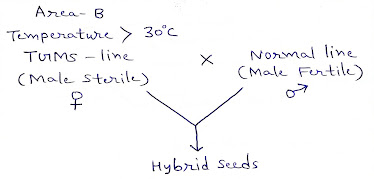
ii. PGMS (Photoperiod sensitive GMS):- धान की फसल में आनुवांशिक नर बंध्यता पर प्रकाशकाल का भी प्रभाव पड़ता है। 10 घण्टे के प्रकाशकाल पर धान के पौधे पूर्णतया नर उर्वर होते हैं जबकि 14 घण्टे के प्रकाशकाल पर धान के पौधे पूर्णतया नर बंध्य होते हैं।
(Photo period also has an effect on genetic male sterility in paddy crop. Paddy plants are fully male fertile at 10 hours of light period, while at 14 hours of light, paddy plants are completely male sterile.)
PGMS line का अनुरक्षण (Maintenance of PGMS line):- इसके लिए धान के पौधों को ऐसे क्षेत्र में उगाया जाता है जहां पर प्रकाशकाल 10 घण्टे के लिए उपलब्ध रहता है। इस प्रकाशकाल पर धान के पौधे पूर्ण नर उर्वर होते हैं। पौधों में स्वपरागण होने देते हैं, जिसके फलस्वरूप PGMS line के पौधे प्राप्त होते हैं जैसा कि नीचे diagram में प्रदर्शित किया गया है।
(For this, paddy plants are grown in an area where light period remain available for 10 hours. Paddy plants are fully male fertile in this condition. Now allow self-pollination in plants, resulting in the production of PGMS line seeds and then plants as shown in the diagram below.)


संकर बीज उत्पादन (Hybrid Seed Production):- इसके लिए धान के पौधों को ऐसे क्षेत्र में उगाया जाता है जहां पर प्रकाशकाल 14 घण्टे के लिए रहता है। इस प्रकाशकाल पर धान के पौधे पूर्ण नर बंध्य होते हैं जिन्हें मादा जनक के रूप में उपयोग किया जा सकता है। अब इन नर बंध्य मादा जनक पौधों का उपयुक्त नर जनक पौधे से क्रॉस कराया जाता है जिसके फलस्वरूप संकर बीज प्राप्त होते हैं जैसा कि नीचे diagram में प्रदर्शित किया गया है।
(For this, paddy plants are grown in an area where the light period lasts for 14 hours. Paddy plants are fully male sterile in this condition which can be used as female parent. Now these male sterile female parent plants are crossed with the appropriate male parent plant, resulting in the production of hybrid seeds as shown in the diagram below.)


2. कोशिकाद्रव्यी नर बंध्यता (Cytoplasmic Male Sterility = CMS):- जब कोशिकाद्रव्य के द्वारा नर बंध्यता का नियंत्रण होता है तो इसे कोशिकाद्रव्यी नर बंध्यता (CMS) कहते हैं। जब निषेचन होता है तो नर जनक से केवल केन्द्रक आता है और मादा जनक से केन्द्रक व कोशिकाद्रव्य दोनों आते हैं। इसलिए जब नर बंध्य मादा जनक का नर जनक से क्रॉस कराया जाता है तो प्राप्त होने वाले संकर बीजों से उत्पन्न होने वाले सभी पौधे नर बंध्य होते हैं जैसा की नीचे diagram में प्रदर्शित किया गया है।
[When male sterility is controlled by cytoplasm, it is called cytoplasmic male sterility (CMS). When fertilization occurs, only the nucleus comes from the male parent, while both the nucleus and cytoplasm come from the female parent. So when the male sterile female parent is crossed with the male parent, all the plants produced from the hybrid seeds are male sterile as shown in the diagram below.]


संकर बीज उत्पादन (Hybrid Seed Production):- ऐसी फसलें जिनमें बीज आर्थिक महत्व का होता है उनमें संकर बीज उत्पादन के लिए CMS का उपयोग नहीं किया जा सकता। परन्तु ऐसी फसलें जिनमें बीज की बजाय कोई कायिक भाग आर्थिक महत्व का होता है उनमें संकर बीज उत्पादन के लिए सीएमएस का उपयोग किया जाता है। जैसे - प्याज, लहसुन, गाजर, मूली आदि।
(CMS cannot be used for hybrid seed production in crops in which seed is of economic importance. But in crops where a somatic part is of economic importance rather than seed, CMS is used for hybrid seed production. Such as onion, garlic, carrot, radish etc.)
3. कोशिकाद्रव्यी आनुवांशिक नर बंध्यता (Cytoplasmic Genetic Male Sterility = CGMS):- जब केन्द्रक तथा कोशिकाद्रव्य दोनों के द्वारा नर बंध्यता का नियंत्रण होता है तो इसे कोशिकाद्रव्यी आनुवांशिक नर बंध्यता (CGMS) कहते हैं। कोशिकाद्रव्य मुख्य नियंत्रक होता है। केन्द्रक में उपस्थित प्रभावी जीन को पुन: स्थापक जीन कहते है जो कोशिकाद्रव्य के नर बंध्य प्रभाव को रोककर नर उर्वरता को पुन: स्थापित करने का कार्य करता है। इसे R से प्रदर्शित करते हैं। r निष्क्रिय जीन होता है।
[When male sterility is controlled by both nucleus and cytoplasm, it is called cytoplasmic genetic male sterility (CGMS). Cytoplasm is the main controller. The dominant gene present in the nucleus is called restorative gene, which acts to restore male fertility by preventing the male sterile effect of cytoplasm. We denote this as R letter. While r is the inactive gene.]
R जीन = नर उर्वरता के लिए
(R gene = For male fertility)
r जीन = निष्क्रिय होता है।
(r gene = For male sterility)
RR = नर उर्वर पौधा (Male fertile plant)
Rr = नर उर्वर पौधा (Male fertile plant)
rr = कोशिकाद्रव्य द्वारा निर्धारण होता है।
(Determined by cytoplasm.)


नीचे diagram में केन्द्रक व कोशिकाद्रव्य के विभिन्न संयोजन दिये गए है:-
(Different combinations of nucleus and cytoplasm are given in the following diagram: -)


संकर बीज उत्पादन (Hybrid Seed Production):- CGMS का संकर बीज उत्पादन में सर्वाधिक उपयोग किया जाता है। CGMS के उपयोग से संकर बीज उत्पादन के लिए Three line system विकसित किया गया है जिसमें निम्न तीन lines होती हैं:
(CGMS is most commonly used in hybrid seed production. A three line system has been developed for hybrid seed production using CGMS which consists of the following three lines:)
i. A – line:- यह नर बंध्य वंशक्रम है जिसे मादा जनक के रूप में उपयोग करते हैं।
(It is a male sterile line that is used as a female parent.)
ii. B – line:- यह नर उर्वर वंशक्रम है जिसे नर जनक के रूप में उपयोग किया जाता है। यह अनुरक्षक line है जो नर बंध्य A – line को अनुरक्षित करने का कार्य करती है।
(It is a male fertile line which is used as a male parent. It is the maintainer line that works to maintain the male sterile A - line.)
iii. R – line:- यह नर उर्वर वंशक्रम है जिसे नर जनक के रूप में उपयोग किया जाता है। यह पुन:स्थापक line है जो नर उर्वरता को पुन: स्थापित करने का कार्य करती है।
(It is a male fertile line which is used as a male parent. It is a restore line that works to restore the male fertility in hybrid plants.)
A – line के अनुरक्षण के लिए इसका क्रॉस B – line के साथ कराया जाता है। संकर बीज उत्पादन के लिए A – line का क्रॉस R – line के साथ कराया जाता है जैसा कि नीचे diagram में प्रदर्शित किया गया है।
(To maintain the A-line, its cross is made with the B-line. For hybrid seed production, the A-line crosses with the R-line as shown in the diagram below.)


.png)